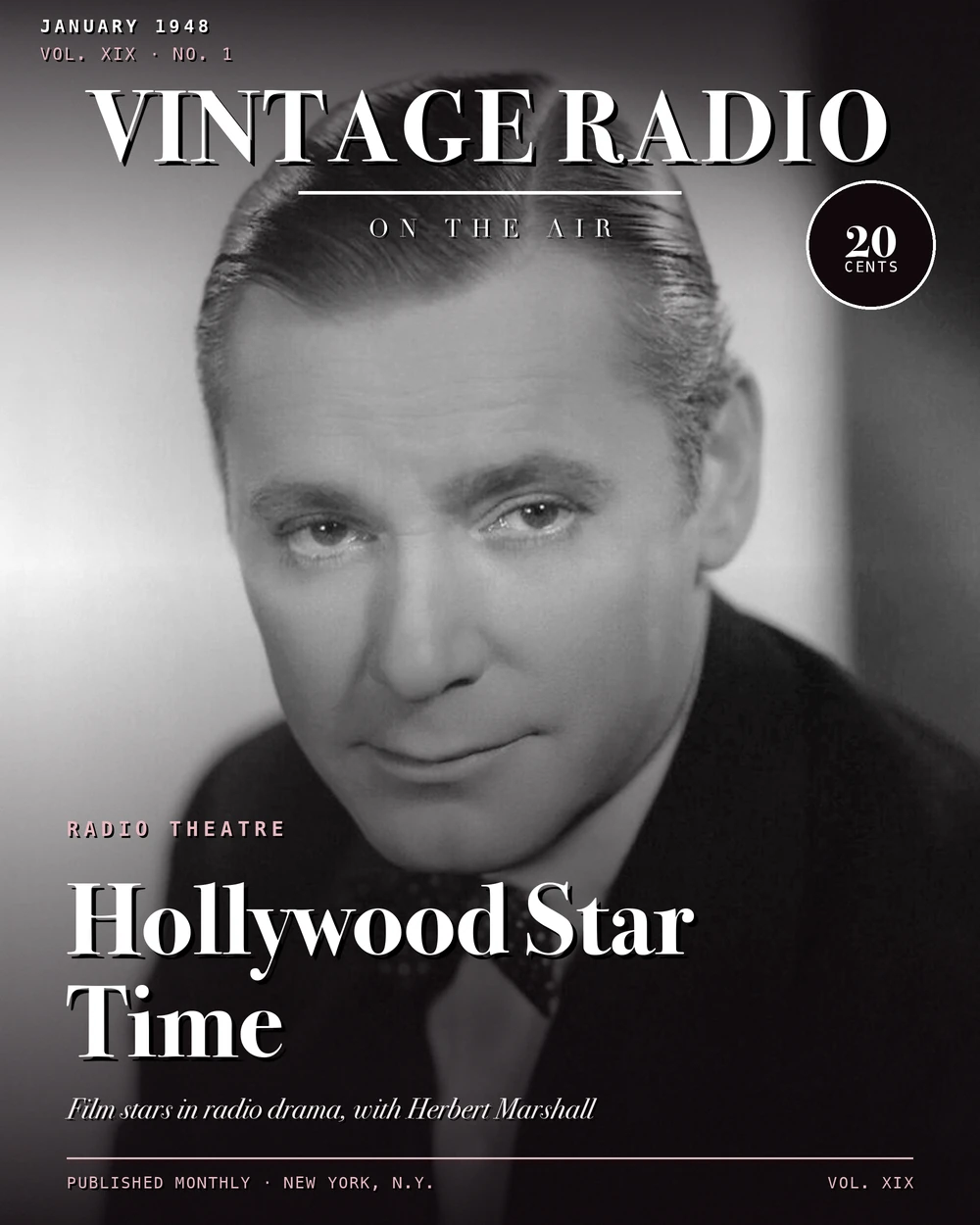
Hollywood Star Time
A Crowded Field and a Tough Format
Hollywood Star Time arrived on CBS on January 6, 1946, with a clear ambition: to compete alongside Lux Radio Theatre as a prestige drama showcase built around major film talent and polished production. The premiere set that tone immediately — CBS persuaded Tyrone Power, just discharged from the U.S. Marine Corps, to appear opposite Jeanne Crain in an adaptation of Seventh Heaven, making it his very first public performance since leaving military service. It was exactly the kind of marquee moment the show needed to signal its intentions.
The problem was that Hollywood Star Time entered a crowded market. The prestige-drama genre already included The Screen Guild Theater, Hollywood Premiere, Academy Award Theater, The Dreft Star Playhouse, and Screen Directors Playhouse, among others. The public had become gorged with Hollywood stardom, and another show built on the same formula felt like old hat before it got comfortable. The show never broke out of single-digit ratings during its run.
There was also a structural disadvantage that no amount of star power could fully overcome. At 30 minutes, the show had only about 23 or 24 minutes of actual content once commercials were factored in. That forced writers to use only key scenes or significantly simplify the plots of the films they were adapting — a real handicap compared to the hour-long Lux Radio Theatre. The fair assessment at the time was that Hollywood Star Time's production matched Screen Guild and ran a notch or so behind Lux — respectable, but not quite enough to stand out.
The Studio Tie-In That Didn't Hold
The show's first season was built around an exclusive arrangement with 20th Century Fox. The studio provided its films as source material; in return, Hollywood Star Time gave Fox on-air promotional plugs. The deal was structured around 13-week option periods, administered through sponsor Frigidaire's advertising agency, Foote, Cone and Belding, and backed by General Motors money.
The Fox connection also brought Alfred Newman to the production. Newman was serving as music director at Fox when the show launched — he had begun a twenty-year tenure there in 1939 — and his role as the show's composer-conductor was a direct extension of the studio relationship. Newman was one of the most decorated film composers of his generation, eventually winning nine Academy Awards from 45 nominations, with credits including The Song of Bernadette, All About Eve, and How the West Was Won. He also composed the fanfare used in Fox's studio logo sequences. His presence gave the show the lush, big-time sound that distinguished it from lesser productions.
One notable moment from that first Fox season came with the February 1946 presentation of Shock, featuring Lynn Bari and Vincent Price. According to a contemporary account in the Mason City Globe-Gazette, it was the first time any 20th Century Fox motion picture had ever been presented in a radio version before the film reached theaters — a promotional experiment that underscored how closely the show and the studio were working together.
The partnership didn't last. After the first 13-week option period, Fox had run out of new productions to promote through the show and opted out of the contract. The show later secured an agreement with Universal-International, which provided exclusive access to that studio's material for the remaining run.
The Cast Across the Run
The talent roster that Hollywood Star Time assembled over its 15 months was genuinely extensive. Beyond the premiere with Power and Crain, the show featured Gene Tierney, Clifton Webb, Linda Darnell, John Payne, Victor Mature, Dana Andrews, Ann Baxter, Henry Fonda, Betty Grable, Ida Lupino, Rex Harrison, Dick Powell, Alan Ladd, Charles Laughton, Judy Garland, Lucille Ball, Walter Pidgeon, Mickey Rooney, and George Burns and Gracie Allen, among many others. Douglas Fairbanks Jr., Roddy McDowall, Robert Montgomery, and Sidney Greenstreet all appeared as well.
The adaptations ranged across Fox and Universal-International material: Laura, The Mark of Zorro, House on 92nd Street, Riders of the Purple Sage, Hangover Square, and The Return of Jesse James, among others. Lee J. Cobb, Vincent Price, and Vanessa Brown appeared together in The Song of Bernadette; Cary Grant, Herbert Marshall, and Marguerite Chapman turned up in Talk of the Town.
Production scripts were adapted by Milton Geiger, a writer born in New York City in 1907 who later contributed to Night Gallery in 1969. Wendell Niles served as announcer. Robert L. Redd and Jack Johnstone shared directing duties across the run.
Herbert Marshall and the Second Season
When the show returned in the fall of 1946, it made a significant structural change: Herbert Marshall became the permanent star-host, formally taking over on October 12, 1946, around the show's 40th episode. The move made practical sense beyond Marshall's reputation. He had made at least 19 appearances on Lux Radio Theatre and at least 16 on The Screen Guild Theatre before taking this role — he was thoroughly at home in the prestige-drama format. And he was already associated with Frigidaire and General Motors through his CBS espionage series The Man Called X, which ran from 1944 to 1952. Same sponsor, same network, same general audience: Marshall was a natural fit.
Marshall himself was an English stage, screen, and radio actor who had become a major Hollywood presence in the 1930s and 1940s — a career built despite losing a leg in World War I. He brought a particular kind of authority to the host role, the kind that came from genuine experience on both sides of the camera rather than simply being a recognizable name.
By the fall of 1946, the show had also expanded its reach. It moved to Saturday nights at 8:00 p.m. beginning at episode 23, with a rebroadcast the same night at 11:00 p.m., and was carried on 149 CBS stations during that fall season, per the CBS Fall 1946 Program Book.
How It Ended
The final broadcast aired on March 27, 1947 — a Thursday at 10:30, a far cry from the Sunday afternoon launch 15 months earlier. The show had shifted time slots several times over its run, and the late-week, late-night placement at the end wasn't the sign of a program gaining momentum.
Hollywood Star Time ran for roughly 65 episodes across its full run. Around 49 recordings are known to survive, with a combined running time of approximately 22 hours and 33 minutes — a reasonably substantial portion of the total output, given how incompletely many shows from the same era survive.
The show's failure to break through was less a matter of execution than of timing and format. The production was solid, the talent was real, and Alfred Newman's scoring gave it a sound that held up against the competition. But 23 minutes of airtime couldn't do what 60 could, the Hollywood prestige-drama market was saturated, and the studio tie-in that was supposed to give the show a promotional edge dissolved after the first quarter. Those structural problems were never really solved — they just accumulated until the show ran out of room.